#예제1
package pkg2.service;

import java.util.Scanner;

public class TryCatchFinallyService {
private Scanner sc = new Scanner(System.in);

	/**
	 * finally 확인하기
	 */
	public void test1() {
		try {
			System.out.println("1. 정상 수행 / 2. 예외 강제 발생 : ");
			int input = sc.nextInt();

			if(input == 1) {
				System.out.println("예외 없이 정상 수행됨");
			}else {
				throw new Exception("강제로 던져진 Exception");
			}

		}catch(Exception e) {
			System.err.println( e.getMessage()   );
		}finally {
			System.out.println("===무조건 수행===");
		}
		}
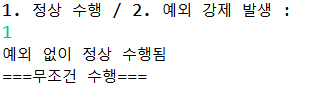
#결과

#예제2
 public void test2() {

		 // Scanner 이용 시 맨날 뜨던 노란줄
		 // -> Resource leak : 'scan' is never closed
		 //    scan이 참조하는 객체가 닫히지 않아서
		 //    자원(메모리)이 누수되고 있어
		 //  -> 키보드와 연결된 통로(Stream)가
		 //      닫히지 않고 남아있어서 메모리가 쓸데없이 소비됨

		 Scanner scan = new Scanner(System.in);

			try {
				System.out.print("1. 정상 수행 / 2. 예외 강제 발생 : ");

				int input = scan.nextInt();

				if(input == 1) {
					System.out.println("예외 없이 정상 수행됨");

				} else {
					throw new Exception("강제로 던져진 Exception");
				}

			} catch(Exception e) {
				System.err.println( e.getMessage() );

			} finally {
				scan.close();
				System.out.println("==== scan close 완료====");
				// 예외 발생 여부 관계없이 무조건!!!
				// 외부 입력 장치와의 통로를 닫아서
				// 메모리를 반환 시켜주는 메서드
				// -> 프로그램 최적화 방법 중 하나


			}


	 }
#결과


'BackEnd > Java' 카테고리의 다른 글
| [Java]예외처리(exception) 사용자 정의 예외 (0) | 2024.08.12 |
|---|---|
| [Java]예외처리(Exception) throw와 throws 구분하기 (0) | 2024.08.12 |
| [Java]예외처리(Exception) (0) | 2024.08.12 |
| [Java]컬렉션(collection) StringBuilder / StringBuffer (0) | 2024.08.12 |
| [Java]컬렉션(collection) String 불변성 (0) | 2024.08.12 |